The Origin of Earth’s Radioactivity
SUMMARY: As the flood began, stresses in the massive fluttering crust generated huge piezoelectric voltages.4 For weeks, powerful electrical surges within Earth’s crust—much like bolts of lightning—produced equally powerful magnetic forces that squeezed (according to Faraday’s Law) atomic nuclei together into highly unstable, superheavy elements that quickly fissioned and decayed into subatomic particles and various isotopes, some of which were radioactive.
Each step in this process is demonstrable on a small scale. Calculations and other evidence show that these events happened on a global scale.5 To quickly understand what happened, see “Earthquakes and Electricity” on page 402, and Figure 6 on page 394.
Evolutionists say Earth’s radioactive material evolved in stars and their exploded debris. Billions of years later, the Earth formed from that debris. Few of the theorized steps can be demonstrated experimentally. Observations on Earth and in space support the hydroplate explanation for Earth’s radioactivity, but refute the evolution explanation.
To contrast and evaluate these radically different explanations for the origin of Earth’s radioactivity, we will first explain some terms. With that background, new and surprising experimental evidence will become clear. Next, the two competing theories will be summarized: the hydroplate theory and the chemical evolution theory. Readers can then judge for themselves which theory better explains the evidence. First, we need to understand a few terms concerning the atom.
The Atom. Descriptions and models of the atom differ. What is certain is that no model proposed so far is completely correct.6 Fortunately, we need not consider these uncertainties here. Let us think of an atom as simply a nucleus surrounded by one or more shells—like layers of an onion. Each shell can hold a certain number of negative charges called electrons. (The innermost shell, for example, can hold two electrons.) The tightly packed, vibrating nucleus contains protons, each with a positive charge, and neutrons, with no charge. (Protons and neutrons are called nucleons.)
An atom is small. Two trillion (2,000,000,000,000, or 2 × 10¹² ) carbon atoms would fit inside the period at the end of this sentence. A nucleus is even smaller. If an atom were the size of a football field, its nucleus—which contains about 99.98% of an atom’s mass—would be the size of a tiny seed ! Electrons are smaller yet. An electron is to a speck of dust as a speck of dust is to the Earth!
Atoms of the same chemical element have the same number of protons. For example, a hydrogen atom has one proton; helium, two; lithium, three; carbon, six; oxygen, eight; iron, 26; gold, 79; and uranium, 92. Today, Earth has 94 naturally occurring chemical elements.7
A carbon-12 atom, by definition, has exactly 12.000000 Atomic Mass Units (AMU). If we could break a carbon-12 atom apart and “weigh” each of its six protons, six neutrons, and six electrons, the sum of their masses would be 12.098940 AMU—which is 0.098940 AMU heavier than the carbon-12 atom itself. To see why an atom weighs less than the sum of its parts, we must understand binding energy.
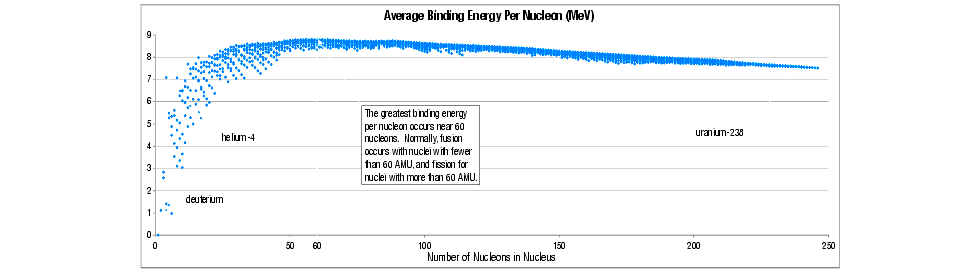
Figure 6: Binding Energy. When separate nucleons (protons and neutrons) come together to form a nucleus, a tiny percentage of their mass instantly disappears and becomes a large amount of energy. That energy (usually measured in units of Millions of electron Volts, or MeV) is called binding energy, because a powerful force—appropriately called the strong force—tightly binds the nucleons together—snaps them powerfully together—producing a burst of heat. Binding energy is also the energy required to unbind a nucleus or cluster of nucleons into their separate protons and neutrons.
For example, a deuterium (hydrogen-2) nucleus contains a proton and a neutron. Its nucleus has a total binding energy of about 2.2 MeV, so the average binding energy per nucleon is about 1.1 MeV. If two deuterium nuclei merge to become helium, 2.2 MeV + 2.2 MeV of binding energy per nucleon are replaced by helium-4’s average binding energy of 7.1 MeV per nucleon, or a total of 4 x 7.1 MeV. The gain in binding energy becomes emitted heat. This merging of light nuclei is called fusion. The Sun produces most of its heat by the fusion of deuterium into helium.8 The peak of the binding energy curve (above) is around 60 AMU (near iron), so fusion normally 9 merges into nuclei lighter than 60 AMU. Fusion that forms elements heavier than 60 AMU absorbs energy.
Fission is the splitting of heavy nuclei. For example, when uranium fissions, the sum of the binding energies of the fragments is greater than the binding energy of the uranium nucleus, so energy is released. Fission (as well as fusion) will continue only if energy is released to generate more fission (or fusion).
The closer the mass of a nucleus is to the mass of an iron or nickel nucleus (60 AMU), the more binding energy that nucleus has per nucleon. [Study Figure 6.] Let’s say that a very heavy nucleus, such as a uranium nucleus weighing 235.0 AMU, splits (fissions) into two nuclei weighing 100.0 AMU and 134.8 AMU and a neutron (0.1 AMU). The 0.1 AMU of lost mass is converted to energy, according to Einstein’s famous equation, E = m c 2, where c is the speed of light (186,000 miles per second), and E is the energy released when a mass m is converted to energy. The energy is great, because c 2 is huge. (For example, when an atomic bomb destroyed Hiroshima, only about 700 milligrams of mass—about one-third the mass of a U.S. dime—was converted to energy.) Nuclear energy is usually released as kinetic energy. The high-velocity fragments generate heat as they slow down during multiple collisions.
Sometimes, a very heavy nucleus splits, a process called fission. Fission may occur when a neutron, or even a high-energy photon (particle of light) hits a heavy nucleus. When fission happens spontaneously—without being hit—it is a type of decay. When fission occurs, mass is lost and energy is released. Likewise, when light nuclei merge (a process called fusion), mass is lost, and energy is released. In an atom bomb, uranium or plutonium nuclei split (fission). In a hydrogen bomb, hydrogen nuclei merge (fuse) to become helium.
Fission inside nuclear reactors produces many free neutrons. Water is an excellent substance for absorbing the energy of fast neutrons and thereby producing heat, because water is cheap and contains so much hydrogen. (A hydrogen atom has about the same mass as a neutron, so hydrogen quickly absorbs a fast neutron’s kinetic energy.) The heat can then boil water to produce steam that spins a turbine and generates electricity.
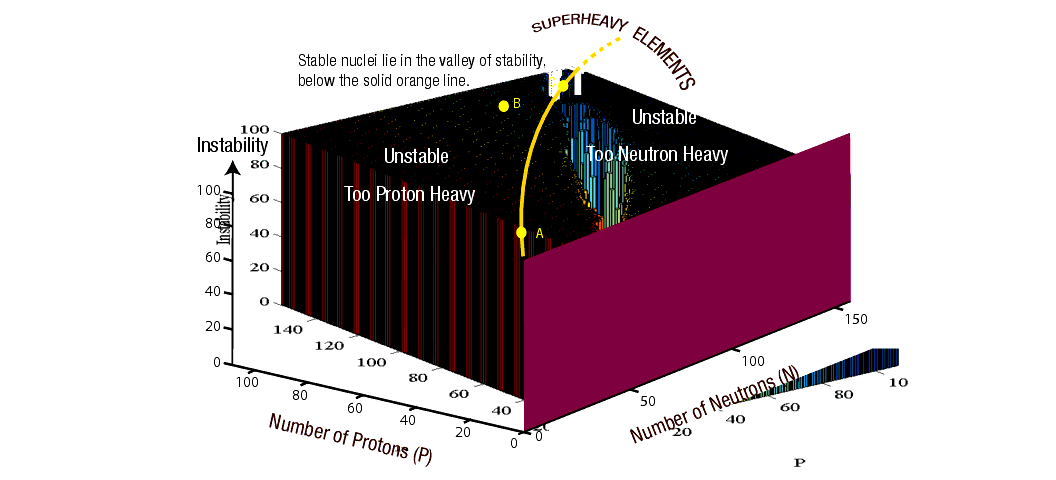
Figure 7: Valley of Stability. Each of the more than 3,100 known isotopes is defined by two numbers: the number of protons (P) and the number of neutrons (N). Think of each isotope as occupying a point on a horizontal P–N coordinate system. A thin, vertical bar represents each isotope’s stability: tall bars for isotopes that decay rapidly, shorter bars for isotopes with longer half-lives, and no vertical bars for stable isotopes.10 Almost 300 stable isotopes are represented far below the curved orange line, in what is called the valley of stability. It lies near the diagonal between the P axis and the N axis.
Almost all isotopes represented by the high, flat “plateau” are so unstable they instantly decay. Most of the thousand or so isotopes briefly observed in experiments lie just below the edge of the “cliff” looking down into the valley. Those on the steep slope have half-lives of seconds to billions of years. Stable isotopes are down on the valley floor. (A billion year half-life does not mean the isotope is billions of years old. It simply means the isotope is fairly stable.)
Notice how the valley curves toward the right.11 Light, stable nuclei have about the same number of protons as neutrons (such as carbon-12 with six protons and six neutrons.) Heavy nuclei that are stable have many more neutrons than protons. A key point to remember: if we could squeeze several light, stable nuclei together to make one heavy nucleus, it would lie high on the proton-heavy side of the valley, be radioactive, and would soon decay.
For example, if some powerful compression or the Z-pinch (described in Figure 5 on page 392) suddenly merged (fused) six stable nuclei near point A, the resulting heavy nucleus would lie at point B, where it would quickly decay or fission.12 Merged nuclei that were even heavier—superheavy nuclei—would momentarily lie far beyond point B, but would instantly fission—fragment into many of our common chemical elements—sometimes uranium. If the valley of stability were straight and did not curve, stable nuclei that fused together would form a stable, heavy nucleus (i.e., would still lie on the valley floor). Nuclei near C that fission will usually produce neutron-heavy products. As you will see, because the valley curves, we have radioactivity—another key point to remember. (Soon, you will read about the “strong force” which produces binding energy and causes the valley to curve.)
All Earth’s nuclei were initially nonradioactive, lying at the bottom of the curved valley of stability—a “very good” condition (Genesis 1:31), because radioactivity damages living organisms. During the early weeks of the flood, chaotic discharges of electrons, driven by billions of volts of electricity, pulsed through the Earth’s crust, producing radioactive isotopes, and their decay products. How this happened will soon be explained. We can think of these new isotopes as being scattered high on the sides of the valley of stability.
It would be as if a powerful explosion, or some sudden release of energy, blasted rocks up onto the steep sides of a long valley. Most rocks would quickly roll back down and dislodge somewhat unstable rocks that were part way up the slope. Today, rocks rarely roll down the sides of the valley. Wouldn’t it be foolish to assume that the rubble at the bottom of this valley must have been accumulating for billions of years, merely because it would take billions of years for all that rubble to collect at the very slow rate rocks roll downhill today?
Later in this chapter, you will see the well-established physical processes that —in less than 1 hour—greatly accelerated radioactive decay during the flood.
Isotopes. Chemical elements with the same number of protons but a different number of neutrons are called isotopes. Every chemical element has several isotopes, although most are seen only briefly in experiments. Carbon-12, carbon-13, and carbon-14 are different isotopes of carbon. All are carbon, because they have 6 protons, but respectively, they have 6, 7, and 8 neutrons—or 12, 13, and 14 nucleons. The number of protons determines the chemical element; the number of neutrons determines the isotope of the element.
Radioactivity. Most isotopes are radioactive; that is, their vibrating, unstable nuclei sometimes change spontaneously (decay), usually by emitting fast, very tiny particles—even photons (particles of light) called gamma rays. Each decay, except gamma emission, converts the nucleus into a new isotope, called the daughter. One type of radioactive decay occurs when a nucleus expels an alpha particle—a tight bundle of two protons and two neutrons, identical to the nucleus of a helium atom. In another type of decay, beta decay, a neutron suddenly emits an electron and becomes a proton. Electron capture, a type of decay, is beta decay in reverse; that is, an atom’s electron enters the nucleus, combines with a proton, and converts it into a neutron. Few scientists realize that on rare occasions heavy nuclei will decay by emitting a carbon-14 nucleus (14C).13 This invalidates the basic assumptions of the radiocarbon dating technique. [See “How Accurate Is Radiocarbon Dating?” on pages 523–527.]
Radioisotopes. Radioactive isotopes are called radioisotopes. Only about 65 naturally occurring radioisotopes are known. However, high-energy processes (such as those occurring in atomic explosions, atomic accelerators, and nuclear reactors) have produced about 3,000 different radioisotopes, including a few previously unknown chemical elements. One, Proto-Uranium, which is now extinct, was the heaviest chemical element known. Its discovery will soon be explained.
Decay Rates. Each radioisotope has a half-life—the time it takes for half of a large sample of that isotope to decay at today’s rate. Half-lives range from less than a billionth of a second to many millions of trillions of years.14 Most attempts to change decay rates have failed. For example, changing temperatures from- 427°F to + 4,500°F produces no measurable change in decay rates. Nor have accelerations of up to 970,000 g, magnetic fields up to 45,000 gauss, or changing elevations or chemical concentrations.
However, we knew as far back as 1971 that high pressure could increase decay rates very slightly for at least 14 isotopes.15 Under great pressure, electrons (especially from the innermost shell) are squeezed closer to the nucleus, making electron capture more likely. Also, electron capture rates for a few radioisotopes change in different chemical compounds.16
Beta decay rates can increase dramatically when atoms are stripped of all their electrons. In 1999, Germany’s Dr. Fritz Bosch showed that, for the rhenium atom, this “decreases its half-life more than a billionfold—from 42-billion years to 33 years.”17 The more electrons removed, the more rapidly neutrons expel electrons (beta decay) and become protons. This effect was previously unknown, because only electrically neutral atoms had been used to measure half-lives.18
Decay rates for silicon-32 (32Si), chlorine-36 (36Cl), manganese-54 (54Mn), and radium-226 (226Ra) depend slightly on Earth’s distance from the Sun.19 They decay, respectively, by beta, alpha, and electron capture. Other radioisotopes are similarly affected. This may be an electrical effect or a consequence of neutrinos20 flowing from the Sun.
Major corporations hold patents for electrical devices that on a small scale accelerate alpha, beta, and gamma decay, thereby decontaminating hazardous nuclear wastes. An interesting patent awarded to William A. Barker is described as follows:21
When a Van de Graaff generator generates 50,000 – 500,000 volts across radioactive material for at least 30 minutes, alpha, beta, and gamma particles sometimes escape. This large negative voltage is thought to lower each nucleus’ energy barrier.
While these electrical devices can safely decontaminate hazardous radioactive material by accelerating decay rates, they are expensive and have decontaminated only small samples. Many nuclear scientists do not understand why they work, but in a few pages you will. Clearly, the common belief that decay rates are constant in all conditions is false.
We can think of a large sample of a radioisotope as a slowly-leaking balloon with a meter that measures the balloon’s total leakage since it was filled. Different radioisotopes have different leakage rates, or half-lives. (Stable isotopes do not leak; they are not radioactive.)
Some may think that a balloon’s age can be determined by dividing the balloon’s total leakage by its leakage rate today. Here, we will address more basic issues: What “pumped up” all radioisotopes in the first place, and when did it happen? Did the pumping process rapidly produce considerable initial leakage—billions of years’ worth, based on today’s slow leakage rates?
Neutron Activation Analysis. This routine, nondestructive technique is used to identify unknown chemical elements. Neutrons, usually from a nuclear reactor, bombard the unknown material. Some nuclei absorb neutrons and become radioactive—are driven up the neutron-heavy side of the valley of stability. [See Figure 7 on page 397.] The decay characteristics of those “pumped up” nuclei then help identify the atoms present.
Neutron Stars. When a very massive star begins to run out of hydrogen and other nuclear fuels, it can collapse so suddenly that almost all its electrons are driven into nuclei. This produces a “sea of neutrons” and releases the immense energy of a supernova. What remains near the center of the gigantic explosion is a dense star, about 10 miles in diameter, composed of neutrons—a neutron star.
The Strong Force. Like charges repel each other, so what keeps a nucleus containing many positively charged protons from flying apart? A poorly understood force inside the nucleus acts over a very short distance to pull protons and neutrons together. Nuclear physicists call this the strong force. Binding energy, described in Figure 6, is the result of work done by the strong force.
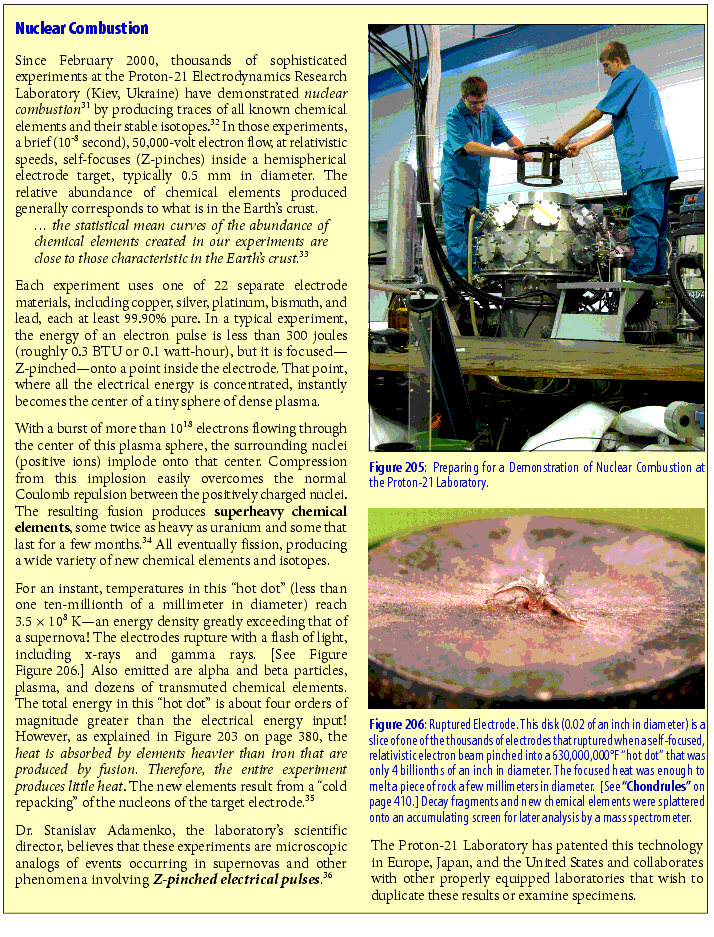
Two nuclei, pushed toward each other, initially experience an increasing repelling force, called the Coulomb force, because both nuclei have positive charges. However, if a voltage is accelerating many nuclei in one direction and electrons are flowing between them in the opposite direction, the intervening electrons largely cancel the repelling force. Furthermore, both positive and negative flows will reinforcing the Z-pinch. [See Figure 5 on page 392.] If the voltage driving both flows is large enough, the Z-pinch brings the two nuclei close enough together so that the strong force merges them into one large nucleus.22
If the Z-pinch acts over a broad plasma flow, many nuclei could merge into superheavy nuclei—nuclei much heavier than any chemical element found naturally. Most merged nuclei would be unstable (radioactive) and would rapidly decay, because they would lie high on the proton-heavy side of the valley of stability. [See Figure 6 on page 394.]
While the strong force holds nuclei together and overcomes the repelling Coulomb force, four particular nuclei are barely held together: lithium-6 (6Li), beryllium-9 (9Be), boron-10 (10B), and boron-11 (11B). Slight impacts will cause their decay.23 The importance of these fragile isotopes will soon become clear.
Free Neutrons. Neutrons in a nucleus rarely decay, but free neutrons (those outside a nucleus) decay with a half-life of about 14.7 minutes! Why would a neutron inside a nucleus have a half-life of millions of years, but, when isolated, have a half-life of minutes? 24 This is similar to what Fritz Bosch discovered: When an intense electric field strips electrons surrounding certain heavy nuclei, those nuclei become so unstable that their decay rate increases, sometimes a billionfold.
Carbon-14. Each year, cosmic radiation striking the upper atmosphere converts about 21 pounds of nitrogen-14 into carbon-14, also called radiocarbon. Carbon-14 has a half-life of 5,730 years. Radiocarbon dating has become much more precise, by using Accelerator Mass Spectrometry (AMS), a technique that counts individual carbon-14 atoms. AMS ages for old carbon-14 specimens are generally about 5,000 years. [See “How Accurate Is Radiocarbon Dating?” on pages 506– 510.] AMS sometimes dates the same materials that were already dated by older, less-precise radiometric dating techniques. In those cases, AMS ages are usually 10–1000 times younger.25
Argon-40. About 1% of Earth’s atmosphere (not counting water vapor) is argon, of which 99.6% is argon-40 and only 0.3% is argon-36. Both are stable. Today, argon-40 is produced almost entirely by electron capture in potassium-40. In 1966, Melvin Cook pointed out the enormous discrepancy in the large amount of argon-40 in our atmosphere, the relatively small amount of potassium-40 in the Earth’s crust, and its slow rate of decay (half-life: 1.3-billion years).
The Earth would have to be about 10 10 years old [10-billion years, twice what evolutionists believe] and the initial 40K [potassium-40] content of the Earth about 100 times greater than at present ... to have generated the 40Ar [argon-40] in the atmosphere.26
Since Cook published that statement, estimates of the amount of 40K in the Earth have increased. Nevertheless, a glaring contradiction remains. Despite geophysicists’ efforts to juggle the numbers, the small amount of 40K in the Earth is not enough to have produced all the 40Ar, the fourth most abundant gas in the atmosphere (after nitrogen, oxygen, and water vapor). If 40Ar was produced by a process other than the slow decay of 40K, as the evidence indicates, then the potassium-argon and argon-argon dating techniques, the most frequently used radiometric dating techniques,27 become useless, if not deceptive.
Likewise, Saturn’s icy moon Enceladus has little 40K, but is jetting too much 40Ar into space from its south pole. Enceladus would need a thousand times its current rock content consisting of the most favorable types of meteorites to explain all of its argon-40.28 Even with that much 40K, how would the argon rapidly escape from the rock and be concentrated? In the previous chapter, we saw that Enceladus and other irregular moons in the solar system are captured asteroids, whose material was expelled from Earth by the fountains of the great deep. Could all that 40Ar have been produced in the subterranean chamber and expelled as part of the debris? Enceladus also contains too much deuterium—about the same amount as in almost all comets and more than ten times the concentration found in the rest of the solar system.29 The comet chapter listed this as one of seventeen major reasons for concluding that the material in comets was launched from Earth by the fountains of the great deep.
One final point: Micrometeorites and solar wind add at least seven times more 36Ar than 40Ar to Earth’s atmosphere. Therefore, those sources provided little of the Earth’s 40Ar, 30 because, as stated above, our atmosphere has about 300 times more 40Ar than 36Ar.
Potassium-40 and Carbon-14. Potassium-40 is the most abundant radioactive substance in the human body and every living thing. (Yes, your body is slightly radioactive!) Fortunately, potassium-40 decays by expelling a not-very-penetrating electron (beta decay). Nevertheless, when potassium-40 decays, it becomes calcium, so if the tiny electron “bullet” didn’t damage you, the sudden change from potassium to calcium could be quite damaging—almost as if a screw in a complex machine suddenly became a nail. While only one ten-thousandth of the potassium atoms in living things is potassium-40, most have already decayed, so living things were at greater risk in the past. How could life have evolved if it had been radioactive?
That question also applies for the rare radioactive isotopes in the chemical elements that are in DNA, such as carbon-14. DNA is the most complex material known. A 160-pound person experiences 2,500 carbon-14 disintegrations each second, almost 10 of which occur each second in the person’s DNA! [See Endnote 4 on page 512.]
The answer to this question is simple. Life did not evolve, and Earth’s radioactivity was not present when life began. Earth’s radioactivity is a consequence of the flood. [See “Mutations” on page 9.]
Zircons. Zircons are tiny, durable crystals about twice the thickness of a human hair. They usually contain small amounts of uranium and thorium, some of which is assumed to have decayed, at today’s very slow rates, to lead. If this is true, zircons are extremely old. For example, hundreds of zircons found in Western Australia would be 4.0 – 4.4-billion years old. Most evolutionists find this puzzling, because they have claimed that the Earth was largely molten prior to 3.9-billion years ago ! 37 These zircons also contain tiny inclusions of quartz, which suggests that the quartz was transported in and precipitated out of liquid water; if so, the Earth was relatively cool and had a granite crust.38 Other zircons, some supposedly as old as 4.42-billion years, contain microdiamonds with abnormally low, but highly variable amounts of 13C. These microdiamonds apparently formed (1) under unusual geological conditions, and (2) under extremely high, and perhaps sudden, pressures before the zircons encased them.39
Helium Retention in Zircons. Uranium and thorium usually decay by emitting alpha particles. Each alpha particle is a helium nucleus that quickly attracts two electrons and becomes a helium atom (4He). The helium gas produced in zircons by uranium and thorium decay should diffuse out relatively quickly, because helium does not combine chemically with other atoms, and it is extremely small—the second smallest of all elements by mass, and the smallest by volume!
Some zircons would be 1.5-billion years old if the lead in them accumulated at today’s rate. But based on the rapid diffusion of helium out of zircons, the lead would have been produced in the last 4,000–8,000 years40—a clear contradiction, suggesting that at least one time in the past, rates were faster.
Helium-3 (3He). Ejected alpha particles, as stated above, quickly become 4He, which constitutes 99.999863% of the Earth’s detectable helium. Only nuclear reactions produce 3He, the remaining 0.000137% of Earth’s known helium. Today, no nuclear reactions are known to produce 3He inside the Earth. Only the hydroplate theory explains how nuclear reactions produced 3He at one time (during the flood) inside the solid Earth (in the fluttering crust).41
3He and 4He are stable (not radioactive). Because nuclear reactions that produce 3He are not known to be occurring inside the Earth, some evolutionists say that 3He must have been primordial—present before the Earth evolved. Therefore, 3He, they say, was trapped in the infalling meteoritic material that formed the Earth. But helium does not combine chemically with anything, so how did such a light, volatile gas get inside meteorites? If helium was trapped in falling meteorites, why did it not quickly escape or bubble out when meteorites supposedly crashed into the molten, evolving Earth?42 Even if 3He atoms were produced inside the Earth, and the mantle has been circulating and mixing for billions of years, why do different volcanoes expel drastically different amounts of 3He, and why—as explained in Figure 55 on page 127—are black smokers expelling large amounts of 3He? 43 Indeed, the small amount of 3He should be so thoroughly mixed and diluted in the circulating mantle that it should be undetectable.44
Where Is Earth’s Radioactivity? Three types of measurements each show that Earth’s radioactivity is concentrated in the relatively thin continental (granite) crust. In 1906, some scientists recognized that just heat from the radioactivity in the granite crust should explain all the heat now coming out of the Earth. If radioactivity were occurring below the crust, even more heat should escape. Because it is not, radioactivity should be concentrated in the top “few tens of kilometers” of the Earth—and have begun recently.
The distribution of radioactive material with depth is unknown, but amounts of the order of those observed at the surface must be confined to a relatively thin layer below the Earth’s surface of the order of a few tens of kilometers in thickness, otherwise more heat would be generated than can be accounted for by the observed loss from the surface.45
Later, holes drilled into the ocean floor showed slightly more heat coming up through the ocean floors than through the continents. But basaltic rocks under the ocean floor contain little radioactivity.46 Therefore, radioactive decay is not the main source of Earth’s geothermal heat.
The second type of measurement occurred in Germany’s Deep Drilling Program. The concentration of radioactivity measured down Germany’s deepest hole (5.7 miles) would account for all the heat flowing out at the Earth’s surface if that concentration continued down to a depth of only 18.8 miles and if the crust were 4-billion years old.47
However, the rate at which temperatures increased with depth was so great that if the trend continued, the rock at the top of the mantle should be partially melted. Seismic studies have shown that this is not the case.48 Therefore, temperatures do not continue increasing down to the mantle, so the heating occurred in the Earth’s crust.
The third measurement technique, used in regions of the United States and Australia, shows a strange, but well-verified, correlation: the amount of heat flowing out of the Earth at specific locations correlates with the radioactivity in surface rocks at those locations. Wherever radioactivity is high, the heat flow will usually be high; wherever radioactivity is low, the heat flow will often be low. However, the radioactivity at those hotter locations is far too small to account for that heat.49 What does this correlation mean?
First, consider what it does not necessarily mean. When two sets of measurements correlate (or correspond), people often mistakenly conclude that one of the things measured (such as radioactivity in surface rocks at one location) caused the other thing being measured (surface heat flow at that location). Even experienced researchers sometimes make this mistake. Students of statistics are repeatedly warned “that correlation does not imply causation,” and are shown hundreds of humorous50 and tragic examples of this common mistake in logic. Nevertheless, the problem abounds in all research fields.
This correlation could be explained if most of the heat flowing up through Earth’s surface was generated, not by radioactivity, but by the events that produced that radioactivity. If more heat is coming out of the ground at one place, then more radioactivity was also produced there. Therefore, radioactivity in surface rocks would correlate with surface heat flow.
The Oklo Natural “Reactor.” Building a nuclear reactor requires the careful design of many interrelated components. Reactors generate heat by the controlled fission of certain isotopes, such as uranium-235 (235U). For reasons that have remained hidden until now, 0.72% of almost every uranium ore deposit in the world is 235U. About 99.27% is the more stable 238U, and 0.01% is 234U. The hydroplate theory’s explanation for the origin of Earth’s radioactivity will explain why this is so in a few pages.) 235U reactors require 235U concentrations of at least 3–5%. This enrichment is both expensive and technically difficult.
Controlling the reactor is a second requirement. When a neutron splits a 235U nucleus, heat and typically two or three other neutrons are released. If the 235U is sufficiently concentrated and, on average, exactly one of those two or three neutrons fissions another 235U nucleus, the reaction continues and is said to be critical—or self-sustaining. If this delicate situation can be maintained, considerable heat (from binding energy) is steadily released, usually for years.
In 1972, French engineers were processing uranium ore from an open-pit mine near the Oklo River in the Gabon Republic on Africa’s west equatorial coast. There, they discovered depleted (partially consumed) 235U in isolated zones.51 (In one zone, only 0.29% of the uranium was 235U, instead of the expected 0.72%.) Many fission products from 235U were also mixed with the depleted 235U but found nowhere else.

Nuclear engineers, aware of just how difficult it is to design and build a nuclear reactor, are amazed by what they believe was a naturally occurring reactor. But notice, we do not know that a self-sustaining, critical reactor operated at Oklo. All we know is that considerable 235U has fissioned.
How could this have happened? Suppose, as is true for every other known uranium mine, Oklo’s uranium layer was never critical. That is, for every 100 neutrons produced by 235U fission, 99 or fewer other neutrons were produced in the next fission cycle, an instant later. The nuclear reaction would quickly die down; i.e., it would not be self-sustaining. However, suppose (as will soon be explained) many free neutrons frequently appeared somewhere in the uranium ore layer. Although the nuclear reaction would not be self-sustaining, the process would multiply the number of neutrons available to fission 235U.52 This would better match what is found at Oklo for four reasons.
First, in several “reactor” zones the ore layer was too thin to become critical. Too many neutrons would have escaped or been absorbed by all the nonfissioning material (called poisons) mixed in with the uranium.53
Second, one zone lies 30 kilometers from the other zones. Whatever strange events at Oklo depleted 235U in 16 largely separated zones was probably common to that region of Africa and not to some specific topography. Uranium deposits are found in many diverse regions worldwide, and yet, only in the Oklo region has this mystery been observed.
Third, depleted 235U was found where it should not be—near the borders of the ore deposit, where neutrons would tend to escape, instead of fission 235U. Had Oklo been a reactor, depleted 235U should be concentrated near the center of the ore body.54
Fourth, at Oklo, the ratio of 235U to 238U in uranium ore, which should be about 0.72 to 99.27 (or 1 to 138), surprisingly varies a thousandfold over distances as small as 0.0004 inch (0.01 mm)! 55 A. A. Harms has explained that this wide variation
represents strong evidence that, rather than being a [thermally] static event, Oklo represented a highly dynamic—indeed, possibly “chaotic” and “pulsing” —phenomenon.56
Harms also explained why rapid spikes in temperature and nuclear power altered the typical ratios of 235U to 238U over very short distances. The subject, “Isotope Ratios,” on page 426 will give a surprising reason why those ratios are normally fixed and what caused the spikes, years after the flood, that altered those ratios of 235U to 238U.
Radiohalos. An alpha particle shot from a radioisotope inside a rock acts like a tiny bullet crashing through the surrounding crystalline structure. The “bullet” travels for a specific distance (usually a few ten-thousandths of an inch) depending on the particular radioisotope and the hardness of the crystals it penetrates. If a billion copies of the same radioisotope are clustered near a microscopic point, their randomly directed “bullets” will begin to form a tiny sphere of discoloration and radiation damage called a radiohalo.59
For example, 238U, after a series of eight alpha decays (and six much less-damaging beta decays), will become lead-206 (206Pb). Therefore, eight concentric spheres, each with a slightly different color and radius, will surround what was a point concentration of a billion 238U atoms. Under a microscope, those radiohalos look like the rings of a tiny onion. [See Figure 10.] A thin slice through the center of this “onion” resembles a bull’s-eye target at an archery range. Each ring’s relative size identifies the radioisotope that produced it.
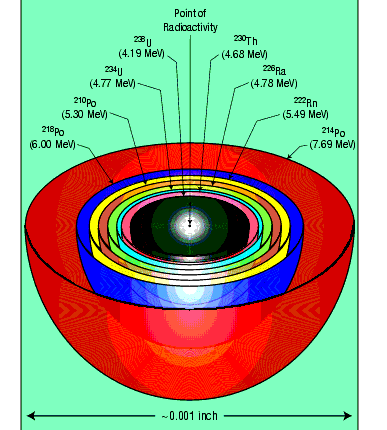
Figure 10: Radiohalos from the 238U Decay Series. Suppose many 238U atoms were concentrated at the point of radioactivity shown here. Each 238U atom eventually ejects one alpha particle in a random direction, but at the specific velocity corresponding to 4.19 million electron volts (MeV) of energy—the binding energy released when 238U decays. That energy determines the distance traveled, so each alpha particle from 238U ends up at the gray spherical shell shown above. (Alpha particles from daughter isotopes will travel to different shells.) Each sharply defined halo requires the ejection of about a billion alpha particles from the common center of all halos, because each alpha particle leaves such a thin path of destruction.
A 238U atom becomes 234U after the alpha decay and two less-damaging beta decays. Later, that 234U atom expels an alpha particle with 4.77 MeV of kinetic energy. As a billion 234U atoms decay, a sharp 234U halo forms. Eventually, a billion lead-206 (206Pb) atoms will occupy the halo center, and each halo’s radius will identify which of the eight radioisotopes produced it.
While we might expect all eight halos to be nested (have a common center) as shown above, G. H. Henderson made a surprising discovery61 in 1939: halos formed by the decay of three polonium isotopes (218Po, 214Po, and 210Po) were often isolated, not nested. Since then, the mystery has deepened, and possible explanations have generated heated controversy.
Thorium-232 (232Th) and 235U also occur naturally in rocks, and each begins a different decay series that produces different polonium isotopes. However, only the 238U series produces isolated polonium halos. Why are isolated polonium halos in the 238U decay series but not in other decay series? If a supernova produced and scattered 235U throughout our galaxy billions of years ago, and the Earth evolved millions of years later from some of that scattered debris, why is 235U still around, since its 700-million-year half-life is relatively short? All that 235U should have decayed and become lead. Where is all that lead? What concentrated 235U in Earth’s crust?
Isolated Polonium Halos. We can think of the eight alpha decays from 238U to 206Pb as eight rungs on a generational ladder. Each alpha decay leads to the radioisotope on the ladder’s next lower rung. The last three alpha decays60 are of the chemical element polonium (Po) : 218Po, 214Po, and 210Po. Their half-lives are extremely short: 3.1 minutes, 0.000164 seconds, and 138 days, respectively.
Surprisingly, polonium radiohalos are often found without their parents—or any other prior generation ! How could that be? Polonium is always a decay product. It must have had parents! Notice that 222Rn is on the rung immediately above the three polonium isotopes, but the 222Rn halo is missing. Because 222Rn decays with a half-life of only 3.8 days, its halo should be found with the polonium halos. Or should it?
Dr. Robert V. Gentry, the world’s leading researcher on radiohalos, has proposed the following explanation for this mystery.62 He correctly notes that halos cannot form in a liquid, so they could not have formed while the rock was solidifying from a molten state. Furthermore, any polonium in the molten rock would have decayed long before the liquid could cool enough to solidify. Therefore, we can all see that those rocks did not cool and solidify over eons, as commonly taught! However, Gentry believes, incorrectly, that on Day 1 of the creation, a billion or so polonium atoms were concentrated at each of many points in rock; then, within days, the polonium decayed and formed isolated (parentless) halos.
Gentry’s explanation has five problems. First, it doesn’t explain what concentrated a billion or so polonium atoms at each of trillions of points that later become the centers of parentless polonium halos. Second, to form a distinct 218Po halo, those 218Po atoms, must undergo heat-releasing alpha decays, half of which would occur within 3.1 minutes. The great heat generated in such a tiny volume in just 3.1 minutes would melt the entire halo. Not only did melting not occur, had the temperature of the halo ever exceeded 300°F (150°C) the alpha tracks would have been erased (annealed).63 Obviously, an efficient heat removal mechanism, which will soon be explained, must have acted.
Third, polonium has 33 known radioisotopes, but only three (218Po, 214Po, and 210Po) account for almost all the isolated polonium halos. Those three are produced only by the 238U decay series, and 238U deposits are often found near isolated polonium halos. Why would only those three isotopes be created instantly on Day 1? This seems unlikely. Instead, something produced by only the 238U decay series accounts for the isolated polonium halos. As you will soon see, that “something” turns out to be 222Rn.
Fourth, Henderson and Sparks, while doing their pioneering work on isolated polonium halos in 1939, made an important discovery: they found that the centers of those halos, at least those in the biotite “books” they examined, were usually concentrated in certain “sheets” inside the biotite.64 (Biotite, like other micas, consists of thin “sheets” that children enjoy peeling off as if the layers were sheets in a book.)
In most cases, it appears that they [the centers of the isolated halos] are concentrated in planes parallel to the plane of cleavage. When a book of biotite is split into thin leaves, most of the latter will be blank until a certain depth is reached, when signs of halos become manifest. A number of halos will then be found in a central section in a single leaf, while the leaves on either side of it show off-centre sections of the same halos. The same mode of occurrence is often found at intervals within the book.65
Apparently, polonium atoms or their 222Rn parent flowed along what is now the central sheet and lodged in the channel wall as that mineral sheet grew. In other words, the polonium was not created on Day 1 inside solid rock.
Fifth, isolated polonium halos are often found near uranium mines, where magma containing uranium was injected up through fossil-bearing strata. Therefore, the intrusions and polonium halos formed after the flood, which itself was long after creation. The magma slowly cooled and solidified, while the uranium began releasing 222Rn that was quickly dissolved and transported upward in flowing water. The polonium daughters of 222Rn produced the parentless polonium halos.
On 23 October 1987, after giving a lecture at Waterloo University near Toronto, Ontario, I was approached by amateur geologist J. Richard Wakefield, who offered to show me a similar intrusion. The site was near a uranium mine, about 150 miles to the northeast near Bancroft, Ontario, where Bob Gentry had obtained some samples of isolated polonium halos. I accepted and called my friend Bob Gentry to invite him to join us. Several days later, he flew in from Tennessee and, along with an impartial geologist who specialized in that region of Ontario, we went to the mine. Although we could not gain access into the mine, we all agreed that the intrusion cut up through the sedimentary layers.66
Gentry concluded while we were there (and later wrote67) that intrusions through sedimentary layers were created supernaturally and contained 218Po, 214Po, and 210Po (but no other polonium isotopes). Then the 218Po, 214Po, and 210Po decayed minutes or days later. Unfortunately, I had to disagree with my friend; the heat generated would have melted the entire halo.68 Besides, those sedimentary layers were laid down during the flood, so the intrusions occurred after the flood—long after the creation, when Gentry claims they formed. [See “Liquefaction: The Origin of Strata and Layered Fossils” on pages 203– 214.] Since 1987, isolated polonium halos have been reported in other flood deposits.69
Dr. Lorence G. Collins has a different explanation for the polonium mystery. He first made several perceptive observations. The most important was that strange wormlike patterns were in “all of the granites in which Gentry found polonium halos.” 70 Those microscopic patterns, each about 1 millimeter long, resembled almost parallel “underground ant tunnels” and were typically filled with two minerals common in granite: quartz and plagioclase [PLA-jee-uh-clase] feldspars, specifically sodium feldspars.71 The granite had not melted, nor had magma been present. The rock that contains these wormlike patterns is called myrmekite [MUR-muh-kite]. Myrmekites have intrigued geologists and mineralogists since 1875. Collins admits that he does not know why myrmekites and isolated polonium halos are found together in granites.72 You soon will.
Collins notes that those halos all seem to be near uranium deposits and tend to be in two minerals (biotite and fluorite) in granitic pegmatites [PEG-muh-tites] and in biotite in granite when myrmekites are present.73 (Pegmatites will soon be described. Biotite, fluorite, and pegmatites form out of hot water solutions in cracks in rocks.) Collins also knows that radon (Rn) inside the Earth’s crust is a gas; under such high pressures, it readily dissolves in hot water. Because radon is inert, it can move freely through solid cracks without combining chemically with minerals lining the walls of those cracks.
Collins correctly concludes that “voluminous” amounts of hot, 222Rn-rich water must have surged up through sheared and fractured rocks.74 When 222Rn decayed, 218Po formed. Collins insights end there, but they raise six questions.
a. What was the source of all that hot, flowing water, and how could it flow so rapidly up through rock? 75
b. Why was the water 222Rn rich? 222Rn has a half-life of only 3.8 days!
c. Because halos are found in different geologic periods, did all this remarkable activity occur repeatedly, but at intervals of millions of years? If so, how?
d. What concentrated a billion or so 218Po atoms at each microscopic speck that became the center of an isolated polonium halo? Why wasn’t the 218Po dispersed?
e. Today’s extremely slow decay of 238U (with a half-life of 4.5-billion years) means that its daughters, granddaughters, etc. today form slowly. Were these microscopic specks the favored resting places for 218Po for billions of years, or did the decay rate of 238U somehow spike just before all that hot water flowed? Remember, 218Po decays today with a half-life of only 3.1 minutes.
f. Why are isolated polonium halos associated with parallel and aligned myrmekite that resembles tiny ant tunnels?
Answers, based on the hydroplate theory, will soon be given.
Elliptical Halos. Robert Gentry made several major discoveries concerning radiohalos, such as elliptical halos in coalified wood from the Rocky Mountains. In one case, he found a spherical 210Po halo superimposed on an elliptical 210Po halo. Apparently, a spherical 210Po halo was forming, but then was suddenly compressed by about 40% into an elliptical shape. Then, the partially depleted 210Po (whose half-life is 138 days) finished its decay, forming the spherical halo.76
Explosive Expansion. Mineralogists have found, at many places on Earth, radial stress fractures surrounding certain minerals that experienced extensive alpha decays. Halos were not seen, because billions of decaying radioisotopes were not concentrated at microscopic points. However, alpha decays throughout those minerals destroyed their crystalline structure, causing them to expand by up to 17% in volume.77
Dr. Paul A. Ramdohr, a famous German mineralogist, observed that these surrounding fractures did not occur, as one would expect, along grain boundaries or along planes of weakness. Instead, the fractures occurred in more random patterns around the expanded material. Ramdohr noted that if the expansion had been slow, only a few cracks—all along surfaces of weakness—would be seen. Because the cracks had many orientations, the expansion must have been “explosive.” 78 What caused this rapid expansion? [See Figure 11 and then read, "When, Where, How, and Why Did Radioactive Decay Rates Accelerate?" on page 411.]
Pegmatites. Pegmatites are rocks with large crystals, typically one inch to several feet in size. Pegmatites appear to have crystallized from hot, watery mixtures containing some chemical components of nearby granite. These mixtures penetrated large, open fractures in the granite where they slowly cooled and solidified. What Herculean force produced the fractures? Often, the granite is part of a huge block, with a top surface area of at least 100 square kilometers (40 square miles), called a batholith. Batholiths are typically granite regions that have pushed up into the overlying, layered sediments, somehow removing the layers they replaced. How was room made for the upthrust granite? Geologists call this “the room problem.” 79
This understanding of batholiths and pegmatites is based primarily on what is seen today. (In other words, we are trying to reason only from the effect we see back to its cause.) A clearer picture of how and when they formed—and what other major events were happening on Earth—will become apparent when we also reason in the opposite direction: from cause to effect. Predictions are also possible when one can reason from cause to effect. Generally, geology looks backward, and physics looks forward. We will do both and will not be satisfied until a detailed picture emerges that is consistent from both vantage points. This will help bring into sharp focus “the origin of Earth’s radioactivity.”
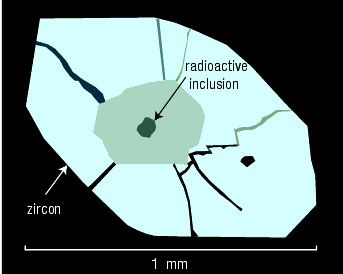
Figure 11: Radial Fractures. Alpha decays within this inclusion caused it to expand significantly, radially fracturing the surrounding zircon that was ten times the diameter of a human hair. These fractures were not along grain boundaries or other surfaces of weakness, as one would expect. Mineralogist Paul Ramdohr concluded that the expansion was explosive. To see why it was explosive, see "When, Where, How, and Why Did Radioactive Decay Rates Accelerate?" on page 411.